The MRI suite can feel cold, loud, and tightly controlled. Before the scan starts, metal screening often raises a blunt question: can you have an MRI with dental implants?
If scans make you nervous, you may find tips to manage dental anxiety helpful.
In most cases, yes. Most modern dental implants are MRI-safe or MRI-conditional, which means they usually do not prevent a scan, but the radiology team still needs to know they are there.
That answer matters because many people with implants are already dealing with something else. The MRI may be part of a cancer workup, neurologic evaluation, chronic illness, or injury care, and dental hardware becomes one more detail to sort out.
The safest step is simple. Tell the imaging center and the ordering clinician about any implant, crown, bridge, denture attachment, or other oral metal before the appointment, even if it has been in place for years.
NK Family Dental in Chicago, IL provides dental implants and implant evaluations, the kind of service that can help clarify MRI compatibility.
Most dental implants are made from titanium or titanium alloys. Titanium is widely used in medicine because it is strong, biocompatible, and not strongly ferromagnetic, which means it is not powerfully pulled by the MRI magnet.
That is why a healed implant in the jaw usually does not move during an MRI. Once the implant has fused to the bone through osseointegration, it is generally stable. Learn more about dental implant surgery.
The bigger issue is often image quality, not danger. Dental metal can create MRI artifacts, which means distortion or shadowing on the image that can make nearby structures harder to see.
This matters most when the MRI is focused on the head, face, jaw, sinuses, brainstem, neck, or temporomandibular joint. If the scan is of the knee, spine, abdomen, or another distant body part, a dental implant usually has little or no practical effect on the images.
Many patients worry that the magnet will rip the implant out. With standard modern dental implants, that is generally not how MRI risk presents.
The more realistic concerns are image artifact, mild local heating in some situations, and uncertainty about exactly what materials are in the mouth. An implant may be straightforward, while the attached abutment, screw, bar, overdenture clip, or older restoration may involve different metals.
Small temperature changes can happen around some metal objects during MRI, but clinically important heating from a routine dental implant is uncommon. The radiology team still screens carefully because MRI risks depend on the full picture, including scanner strength, body area, and device materials.
Older dental hardware can make the conversation less clear. The same is true for implants placed abroad, treatment done decades ago, or cases where records are missing.
That uncertainty is common. People move, offices close, and patients with interrupted care may not have easy access to implant details when an MRI is needed quickly.
A dental implant may matter more for the radiologist than for the patient. If the scan is looking at tissues close to the mouth, the implant can create distortion that partly hides anatomy.
This matters most for MRI of the face, oral cavity, salivary glands, jaw joints, upper neck, and parts of the brain near the skull base. Artifact near the implant can limit what the scan shows, even when the implant itself is not unsafe.
In some cases, the imaging center can adjust the MRI technique to reduce distortion. In others, a CT scan or another imaging method may give clearer information, depending on the clinical question.
If the MRI is for the lower back, shoulder, pelvis, or knee, a dental implant is usually just a screening note. It often does not change the scan plan at all.
That distinction helps reduce unnecessary fear. Having a dental implant does not automatically mean MRI is off the table.
Tell the imaging center that you have dental implants as soon as the MRI is scheduled. If possible, do not wait until check-in.
Useful details include when the implant was placed, where it is in the mouth, whether there are multiple implants, and whether there are attached bars, clips, or removable overdenture parts. If you have an implant card, treatment summary, or records from the dentist or oral surgeon, bring them.
If you do not know the brand or material, say that clearly. Unknown implant details do not always cancel an MRI, but they may lead the imaging center to ask for more information before moving forward.
This step can be especially important for patients who have had fragmented care. Community clinics, hospital dental services, and private offices may each hold part of the record.
Dental implants are only one kind of oral metal. Crowns, bridges, fillings, orthodontic wires, retainers, dentures with metal frameworks, and surgical plates can raise different MRI questions.
A fixed titanium implant in bone is not the same as a removable appliance with several metal parts. Orthodontic appliances and some removable prosthetic components may be more likely to affect image quality, especially in head and neck studies.
For patients comparing tooth-replacement options, read our guide on implants or dentures.
If a patient has extensive dental work, the imaging team may ask broader questions than whether implants are present. That is normal and part of standard MRI safety screening.
Contact the dental office or a general dentistry practice that placed the implant if the imaging center asks for documentation or if the implant is old and the details are unclear. A simple confirmation of the implant system or material may be enough.
If you want a broader overview, see our guide to dental implant questions.
This can be frustrating when the MRI feels urgent. It can be even harder for patients dealing with language barriers, transportation problems, unstable housing, or long gaps in care.
Those barriers are easy to miss in a system built around forms and portals. But they often shape who gets delayed, who misses appointments, and who has to keep repeating a medical history that should already be documented.
If records cannot be found, the radiology team may still be able to make a decision based on the available information. The key is early communication, not silence.
Extra caution may be needed if the oral hardware is not a routine endosseous implant, meaning a standard implant placed into the jawbone. Zygomatic implants, older magnetic attachments, facial prosthetic hardware, bone plates, or mixed reconstructive devices may need more detailed review.
You should also speak up if there is pain, looseness, recent surgery, swelling, or uncertainty about what is in the mouth. Those details do not automatically make MRI unsafe, but they may change how the case is assessed.
Urgent review is appropriate when implant details are unknown and the scan involves the head or neck, or when the patient has multiple implanted devices elsewhere in the body. The MRI team needs the full device history, not just the dental part.
If severe symptoms are the reason for the scan, do not delay emergency medical evaluation while trying to sort out dental records on your own.
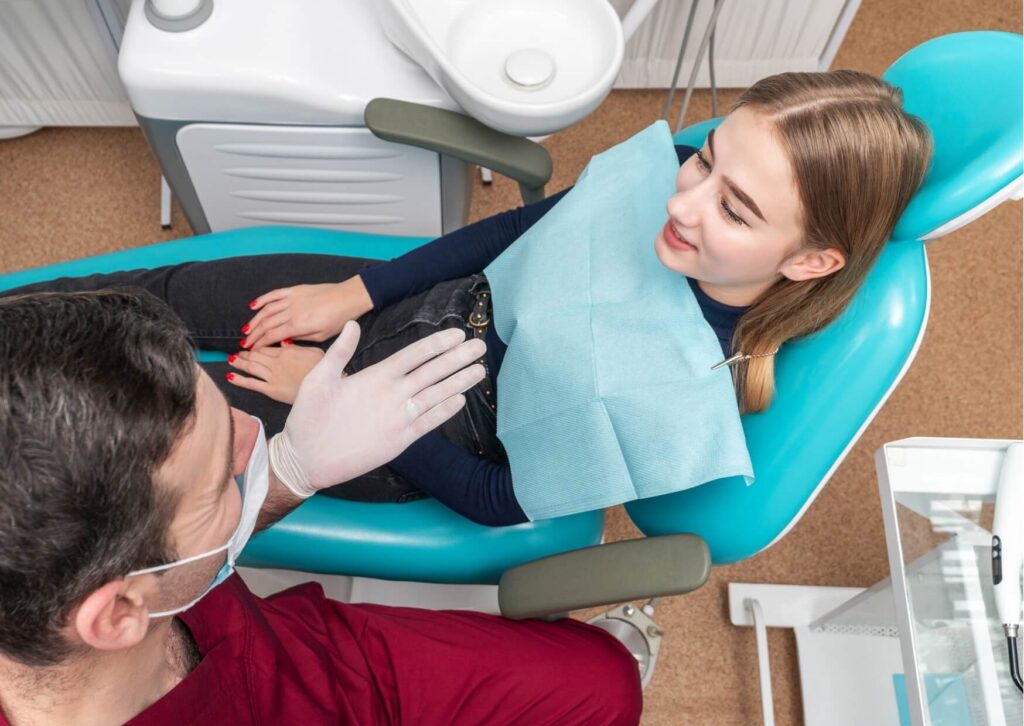
For most patients, the practical answer is reassuring. Dental implants usually do not prevent an MRI, but they should always be disclosed before the scan.
The main question is often whether the implant will distort images near the mouth, not whether it will be pulled out by the magnet. That shift matters because it moves the conversation from fear to planning.
Good care is rarely just about the device itself. It is also about whether the patient can get clear information, whether records are available when needed, and whether the system makes room for people whose histories are incomplete.
If you are scheduling an MRI and have dental implants, tell the imaging center early and ask whether any records are needed ahead of time. That one step often prevents delays and helps the scan move forward with fewer surprises.
NK Family Dental in Chicago provides dental implant evaluations and documentation; call (773) 249-4700 to schedule, and we also serve nearby Logan Square.
That is unlikely with a standard modern implant that is healed and integrated with bone. Most concern centers on image artifact, not implant movement.
Removable dental appliances, retainers, or overdenture components may need separate review. Follow the imaging center's instructions, and do not assume every oral device can stay in place.
A routine MRI does not usually damage a modern dental implant. The radiology team still checks the type of implant and any attached components before the scan.
Tell the imaging center that the implant details are unknown. They may ask for dental records, but unknown details do not always mean the MRI must be canceled.
Not necessarily. CT and MRI answer different clinical questions. If dental metal is likely to distort an MRI of the head or neck, the clinician may consider another imaging approach based on what needs to be evaluated.
Please confirm you're not a robot to proceed to the secure payment page.